

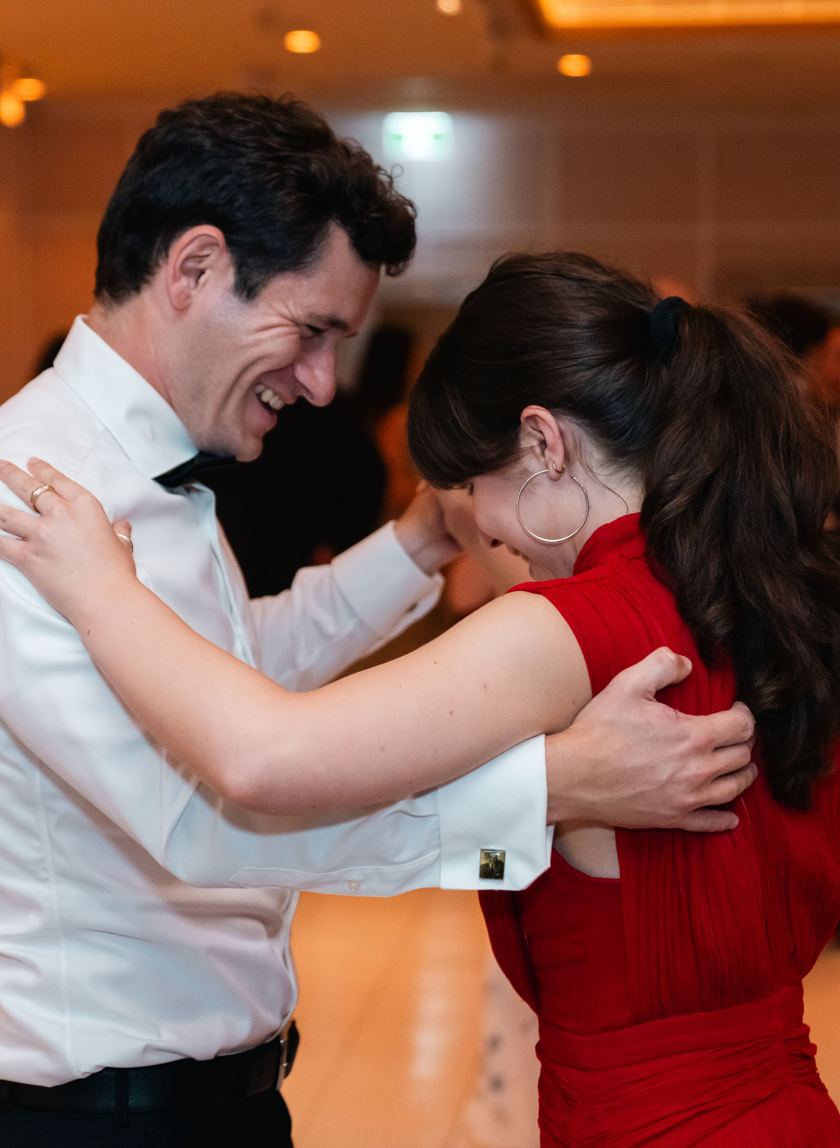
The best father daughter dance songs are ones you both love, with a steady beat you can hear and a meaning nobody needs explained, trimmed to around two to three minutes. Below is our shortlist of songs that work, plus what we have learned from coaching a great many nervous dads: simple steps, editing the track, timing at the reception and the mother son version.
How to choose a father daughter dance song
Start with the two of you, not a list. The song that works is usually one with a story attached: what he played in the car on the way to school, the record that was always on at family barbecues, the one you both sing badly. Guests feel that history even if nobody explains it.
Then check it as dance music. A steady, moderate beat is far easier than a song that drifts or speeds up, and the lyrics deserve a full read, because plenty of tender-sounding songs are about breakups. Our guide to choosing a first dance song goes deeper on tempo and feel.
Still torn? Walk around the lounge room together in time to each candidate; the one where walking feels natural is usually your song. Help with song choice is part of our father daughter dance lessons.
Father daughter dance songs that work on the floor
Real, widely loved songs with a beat you can find. Treat them as a starting point: if a song from your own family's soundtrack fits better, it wins.
Classic and sentimental
Slower songs for a gentle sway or a simple walking step, and possibly a tissue.
- What a Wonderful World, Louis Armstrong. Unhurried, warm and already short, so it rarely needs editing.
- Unforgettable, Natalie Cole with Nat King Cole. A daughter singing alongside her late father on a studio duet, which says it all before you take a step.
- Daddy's Little Girl, The Mills Brothers. An old-fashioned standard that does exactly what the title promises, at an easy swaying pace.
- Butterfly Kisses, Bob Carlisle. The famous tear-jerker of the genre, so choose it knowingly and keep tissues in a pocket.
- In My Life, The Beatles. Reflective without being heavy, and short enough to dance from start to finish.
Lighter and brighter
Mid-tempo songs for families who would rather smile than cry, and for dads who relax once there is a bit of bounce.
- My Girl, The Temptations. Sunny, short and instantly recognisable, so half the room ends up singing along.
- Isn't She Lovely, Stevie Wonder. Written to celebrate the birth of his daughter; the album version runs long, so plan an edit.
- Father and Daughter, Paul Simon. Light and lilting, with the occasion in its title and an easy beat to step to.
- Forever Young, Rod Stewart. A parent's good wishes over a steady beat, which feels like a celebration rather than a farewell.
How long should a father daughter dance be?
Two to three minutes is the sweet spot. That is long enough for a real moment and short enough that nobody, least of all Dad, starts counting bars. Most songs run longer, so editing is normal, not a compromise.
Fade out at the end of a chorus or a musical phrase, never mid-line, so the ending sounds deliberate. Your DJ can usually do the edit for you. With a live band, agree the length and the ending in advance, because live versions change from night to night. Whatever you settle on, practise to that exact version.
Simple steps that look good
You do not need choreography to look lovely. You need a comfortable hold, a few moves you can do without thinking, and a planned start and finish. This is the toolkit we usually start with:
- A relaxed hold. His right hand on her upper back, her left hand on his shoulder, the other two hands joined at about shoulder height.
- The sway and walk. Shift your weight from foot to foot in time, then walk slowly in a small circle, which reads as dancing from anywhere in the room.
- The side-together step. Step to the side, close the feet, repeat; it travels a little and looks neater than a sway on its own.
- One underarm turn. He raises his left hand and she turns beneath it at walking pace, ideally on a chorus so it lands with the music.
- A rehearsed finish. A final turn into a hug, or a small bow to each other, tells the room it is over and cues the applause.
Check the practical things early. Her dress may have a train or a fitted skirt that shortens her step, so rehearse in shoes of the same height, and find out how big the venue's dance floor is before planning a grand circle. Hand positions and the sway are covered in detail in our guide to how to slow dance.
When the parent dances happen at the reception
There is no fixed rule. A common order is the couple's first dance, the father daughter dance, the mother son dance, then the floor opens to everyone; some couples prefer the parent dances after the speeches, when the room is already sentimental.
Give the MC and the DJ or band the order, the song and the exact version, and ask them to start the music only once you are in hold. Ten calm seconds at the start is worth more than any step.
Mother son dances and other parent dances at a wedding
The mother son dance follows the same rules: a song you both like, two to three minutes, a simple hold, a sway and a turn or two. Sons are often as nervous as dads. A Song for Mama by Boyz II Men and Wind Beneath My Wings by Bette Midler are long-standing favourites.
Families vary, and parent dances at a wedding can too. Some couples share one song for both parent dances and swap partners halfway. Others dance with a stepfather, a grandparent or an uncle, or invite every parent onto the floor together.
If a parent has passed away, a short dance with another family member, or a song of theirs played while the couple dances, can be handled with real tenderness. There is no wrong version, only the one that suits your family.
Handling nerves, and how lessons help
Nerves are normal and they shrink quickly with practice. Most dads we teach arrive convinced they have two left feet. The cure is repetition: once the steps live in your body, your head is free to enjoy the moment.
On the day, look at each other rather than your feet, keep your steps small and talk while you dance. If you lose your place, sway until the next chorus: nobody in the room knows the plan except you two.
A few private wedding dance lessons make the whole thing easier. Your teacher builds steps around both of you, allowing for height, the dress and the song, and gives you a clear plan to practise at home. A free introductory private session is the easiest way to see what you need, and our guide to how many wedding dance lessons you need helps with the timeline.
Common questions
Can the father daughter dance turn into a surprise mash up?
Yes, and it is a lovely way to end. Start slow and sentimental, then cut to an upbeat track, sometimes with the bridal party joining in. Rehearse both halves and especially the switch, which is where most mash ups wobble, and give the DJ one edited file rather than two separate songs.
What if my dad really does not want to dance?
Keep it short, keep it to a sway and a walk, and agree that the moment matters more than the steps. Many reluctant dads change their minds after one private lesson in a room with no audience. You can also have the MC invite guests onto the floor halfway through, which takes the spotlight off him.
How far ahead should we start practising?
Earlier is calmer. A simple parent dance does not need months, but starting well before the final weeks leaves room for a dress fitting, a song change or a busy diary. If the couple is already preparing their first dance, folding the parent dance into that plan works well, and short timelines can still be tailored.