

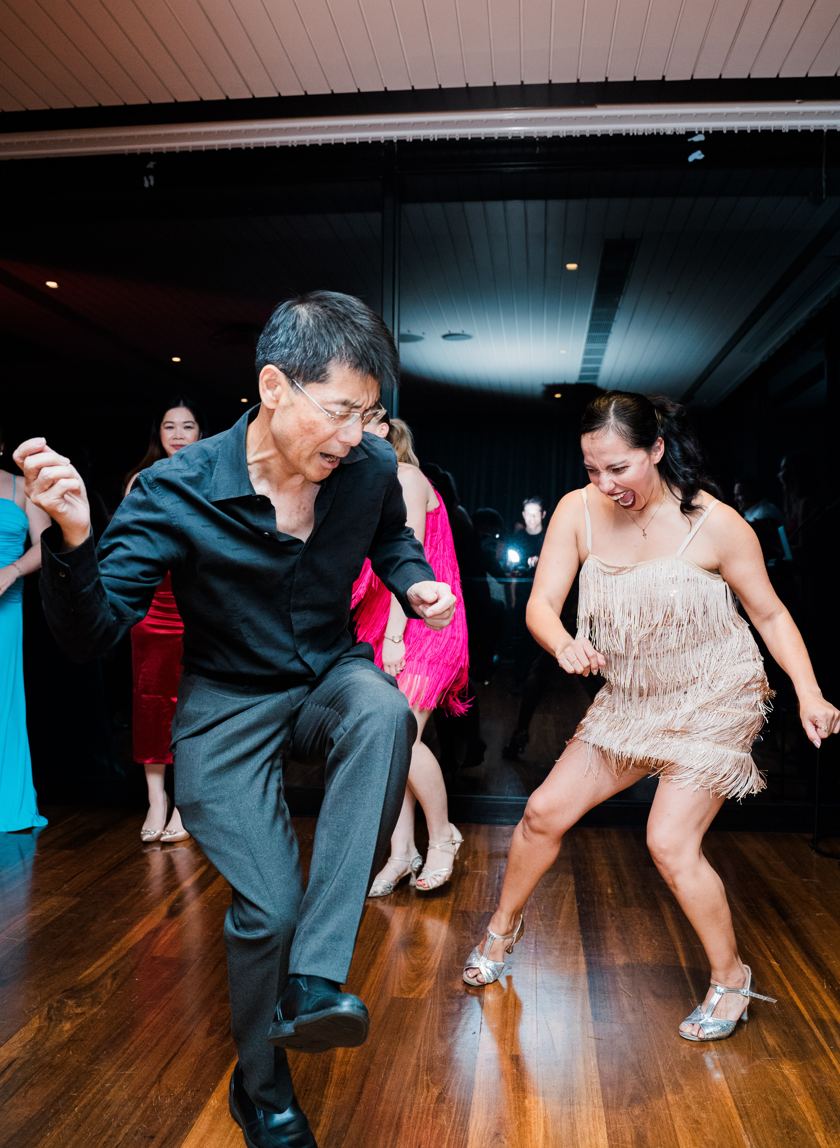
Learning how to slow dance takes minutes: a comfortable hold, a gentle sway from foot to foot in time with the music, and a slow turn now and then. The polish takes a little longer, so here is the whole method, from where your hands go to the point where a slow rumba or a waltz becomes the natural upgrade.
Where to put your hands when slow dancing
There are two holds worth knowing, and both are correct. Who leads is up to you; if you are unsure, our guide to leading and following explains how it works.
The closed hold
This is the classic ballroom version. The leader's right hand rests on the partner's upper back, around the shoulder blade rather than the lower back, and the partner's left hand rests lightly on the leader's right shoulder or upper arm. The free hands join at about shoulder height, elbows soft. Shift half a step so your partner is slightly to your right, and your feet will not collide.
The casual hold
This is the one most people picture: one partner's hands on the other's waist, the other's hands on their shoulders. It is relaxed and perfectly fine at a party or a wedding. It is harder to lead a turn from, so if you want to do more than sway, move into the closed hold.
The basic sway for slow dancing beginners
Stand with your feet about hip-width apart and your knees soft. On one beat, shift your weight onto one foot; on the next, shift it onto the other. The leader starts with their left foot and the partner mirrors with their right, so you move to the same side together.
The common mistake is swaying from the shoulders like a metronome. Move from the feet and hips and keep the upper body quiet. Full weight changes, all the way onto one foot and then all the way onto the other, make even the simplest dance look settled.
This weight change is also the foundation of the rumba, which is why a rumba wedding dance is the natural next step for couples who like the feel of a slow sway.
The side-together step and turning slowly
Once the sway feels easy, travel a little. The leader steps to the side with the left foot and closes the right foot to it, then steps right and closes the left. The partner mirrors. Keep each step no wider than your hips.
To turn, keep doing the side-together step but angle it slightly each time, so you rotate as a pair. A full circle over eight or more steps is plenty; any faster and it becomes a spin. The turn is led through the whole body, not the hands: the leader turns their chest and the partner follows.
Keeping time to a slow song
Slow songs can be harder to follow than fast ones, because the beat hides under the strings or the vocals. Listen for the bass or the drum and step once per beat. If that feels rushed, step once every two beats instead; it still looks right as long as you are consistent.
If you lose the beat, stop travelling and sway on the spot until you find it again. Nobody will notice, and it looks far better than marching out of time.
How to slow dance with a partner: eye contact and conversation
Slow dancing is close, and that can feel intense. You do not need to gaze into each other's eyes for three minutes: look, smile, look over their shoulder, look back. Talking is allowed and, for nerves, it is the best tool there is.
With a new partner at a wedding or a work function, keep the hold a little more open, the conversation light and the steps simple. If they would rather keep a polite distance, that is the dance you do. There is more on the etiquette in our guide to dancing at a wedding as a guest.
Making your slow dance look better
- Stand tall. Lift through the top of your head and let your shoulders drop; posture does more than any step.
- Keep steps small. Big steps make you lurch, while small steps make you look as if you are gliding.
- Soften your knees. Locked knees make you stiff and bouncy, and soft knees let each weight change flow.
- Keep your arms steady. Toned but not rigid, so your partner can feel where you are going.
- Look up, not down. Your feet will still be there, and staring at them pulls your posture forward.
When a slow rumba or a waltz is the upgrade
A sway is lovely, but if a first dance, an anniversary or a slow dance at a wedding is coming up, it can become a real dance with surprisingly little extra. A slow rumba keeps the same weight changes and adds a basic box, a few turns and perhaps a gentle dip. If your song is in three-four time, a waltz adds travel and a graceful rise and fall; waltz for beginners is the place to start.
Both are well within reach of complete beginners. Our wedding dance lessons for beginners pick up exactly where this guide leaves off, and a free introductory private session is a relaxed way to see what is possible with your song. Still choosing the music? Read how to choose your first dance song first.
Common questions
How do you slow dance with someone much taller or shorter?
Adjust the hold rather than your posture. With a big height difference, the shorter partner's hand can rest on the upper arm instead of the shoulder, and the joined hands sit lower, around the shorter partner's shoulder height. Both of you should still stand tall, because hunching down or reaching up is what makes it uncomfortable.
Who leads in a slow dance?
Traditionally the man leads, but any partner can, and many couples simply choose whoever is more comfortable. The leader decides when to travel and turn, and the partner responds. In a simple sway it barely matters, as long as one of you starts the movement and the other goes with it rather than against it.
How long does it take to slow dance well?
The basic sway takes minutes. Looking settled, with a step, a turn and good posture, usually comes after a little practice at home and some guidance from a teacher. A choreographed slow rumba or waltz for a wedding is a bigger project, and it depends on your song, your starting point and how much time you have.