

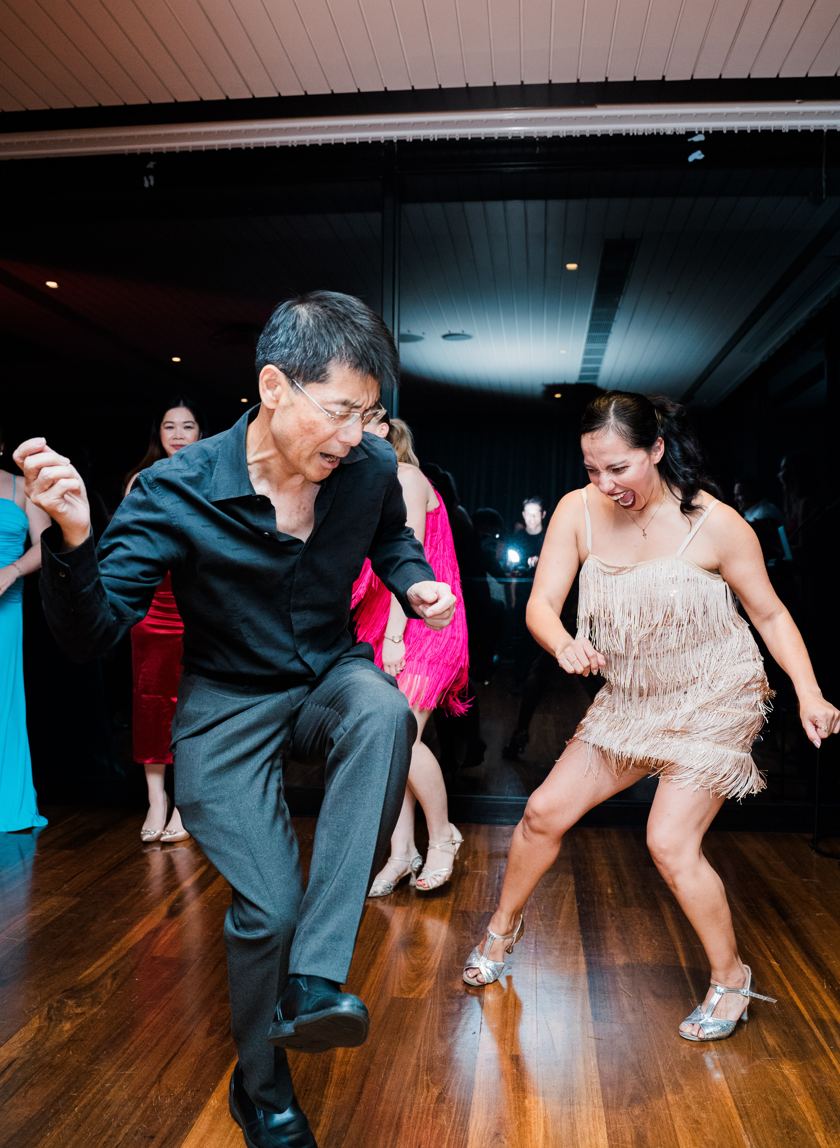
Good dance etiquette is mostly kindness with a few practical rules attached: ask clearly, accept a no gracefully, dance at your partner's level, and keep the floor safe for everyone. None of it is stuffy, and most of it is common sense once someone has said it out loud. Here is what we tell students before their first social night, so you can relax and enjoy it.
How to ask someone to dance
Keep it simple: walk over, make eye contact, smile and ask. Would you like to dance? does the job perfectly, with an offered hand if you like. Wait until a song ends rather than interrupting a couple mid-dance, and never tow someone onto the floor by the wrist, however friendly the intention.
Anyone can ask anyone. Leaders ask followers, followers ask leaders, beginners ask teachers, and at our monthly social dance parties the teachers are out on the floor too, which makes them the safest first ask in the room.
Accepting, declining and saying thank you
Saying yes is easy, so the real etiquette is in saying no. You are always allowed to decline, for any reason, and a simple thank you, I'm sitting this one out is enough. If you would like to dance with that person later, say so, and then make a point of finding them.
One courtesy is worth knowing: if you decline someone, don't step straight onto the floor with someone else for the same song. And if you are the one declined, smile, say no problem and ask someone else. Nobody keeps score, and a no to one song is rarely a no to you.
When the song ends, thank your partner and, if you led them onto the floor, walk them back off it. A dance usually means one song, or two if you are both enjoying yourselves. At an Argentine tango milonga, saying thank you between songs usually means you are finished, so save it for the end.
Dance at your partner's level
A social dance is not a chance to show off your full repertoire; it is a few minutes of making your partner feel good. With a beginner, dance the figures they know, a little slower and clearer than usual. With someone more experienced, relax and let them set the tone, without trying to keep up by guessing.
This matters in both roles. Leaders should never lead a figure the follower has not learned, and followers should not add flourishes that pull the leader off balance. Our guide to leading and following explains why the most sought-after dancers on any floor are the ones who adjust.
Ballroom dance etiquette: line of dance and floor craft
In the travelling ballroom dances, such as the waltz, foxtrot, ballroom tango and Viennese waltz, couples move anticlockwise around the room along what is called the line of dance. Faster couples use the outside of the floor, so if you are newer or slower, drift a little towards the inside and let others pass. Never stop dead or wander across the outer lane, for the same reason you would not park in the middle of a roundabout.
Spot dances such as the rumba and cha cha stay roughly in one place, so they belong in the centre of the floor when travelling dances are going on around them. Leaders take care of steering, while followers keep an eye on what is behind the leader and give a gentle squeeze on the shoulder if a collision is coming. If you do bump someone, apologise, check they are fine and carry on.
No teaching on the social floor
This is the golden rule, and the one most often broken by well-meaning people. Unless your partner asks for help, do not correct, coach or explain anything during a social dance. It makes the other person feel judged, it slows the whole floor, and the problem is usually a shared one anyway.
If a figure is not working, quietly drop back to something simpler that does. Save the questions for your next lesson, where they belong and where the answer will be right. The one exception is comfort and safety: if something hurts or a hold feels wrong, say so straight away.
Hygiene, shoes and small courtesies
Partner dancing is close, so a little preparation goes a long way. None of this is about looking glamorous, only about being pleasant to stand near.
- Freshen up. Shower, use deodorant and go easy on perfume or aftershave, since your partner will be breathing it for the length of a song.
- Bring a spare top. Dancing is exercise, and a fresh shirt halfway through the night is a kindness to everyone you dance with after it.
- Mind your breath. Mints are standard kit, and a garlic-heavy dinner before a social is a bold choice.
- Wear smooth-soled shoes. Grippy soles catch on turns and strain knees, and outdoor grit scratches the floor, so see our notes on what to wear for dancing.
- Skip the snags. Big rings, sharp bracelets and long necklaces can catch hands and hair, so leave them in your bag.
Your first social night: dealing with nerves
Nearly everyone is nervous at their first social, including dancers who now look completely at home. Go with someone from your lessons, arrive early while the floor is quieter, and start with the dance you know best. Sitting out a few songs to watch is perfectly normal, and so is leaving after an hour if that was all you wanted.
It helps to remember that nobody is watching you as closely as you are. Our parties have a different theme each month, so there is plenty to talk about besides footwork, and students at every level are trying out new steps side by side. If you would like to feel floor-ready first, our social dance classes build the figures you will actually use, and the free introductory private session is the easiest place to start.
Common questions
Can women ask men to dance?
Of course. On a social floor anyone can ask anyone, and followers asking leaders is completely normal. It is also one of the quickest ways to get more dances on a busy night. The same manners apply in both directions: ask clearly, accept the answer with a smile, and say thank you at the end.
Is it okay to dance only with your own partner?
Yes, and plenty of couples do. If you came as a pair, there is no rule that says you must swap. Dancing with others now and then is still worth it, because every partner leads or follows a little differently and you both learn faster for it. Agree on how you want the night to go before you arrive, so nobody is surprised.
What should I wear to a social dance party?
Something comfortable you can move in, with shoes that let you turn. Our parties each have a theme, so you can join in with a costume nod if you like, and nobody minds if you don't. For dinner and dance nights it is fun to dress up a little more, and our social dancing events page shows what they look like.
What if I forget everything as soon as the music starts?
Then you are in excellent company. Go back to your basic step and dance it well: a confident basic in time with the music is a perfectly good social dance, and your partner will enjoy it far more than a nervous attempt at something complicated. Confidence on the floor grows with use, which we write about in learning to dance with confidence.