

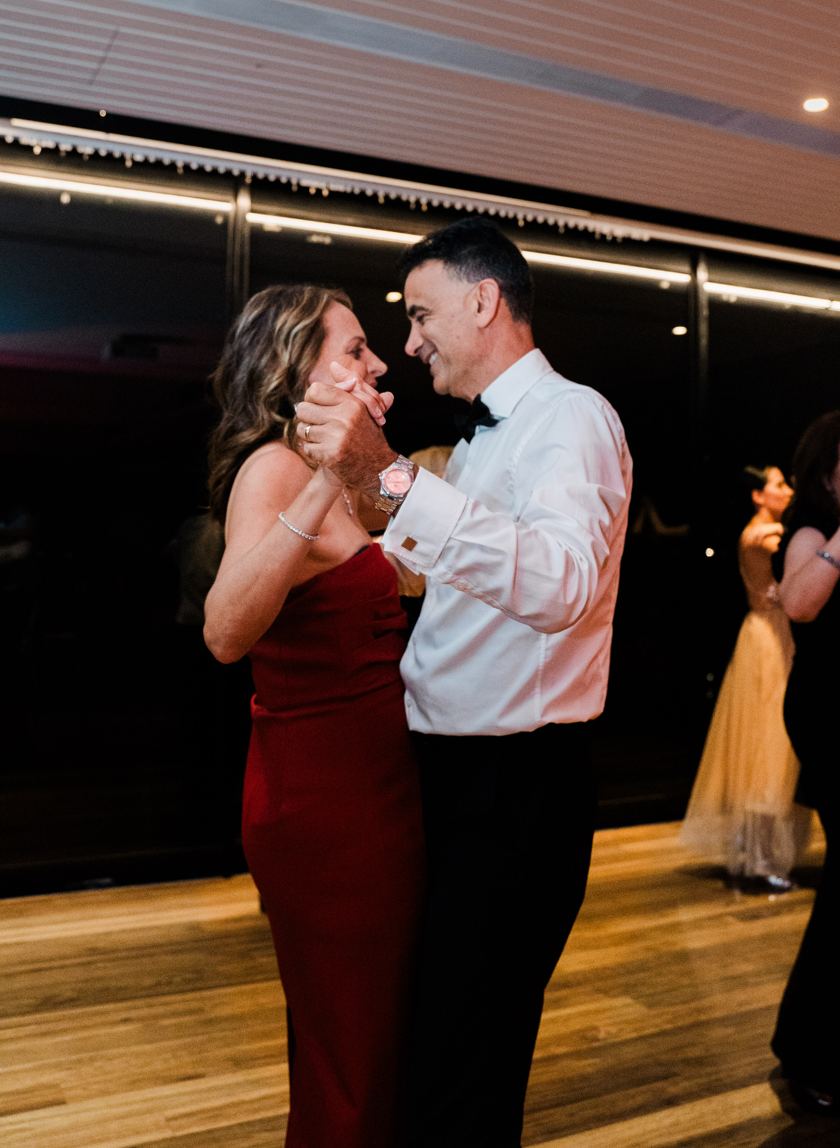
Knowing how to dance at a party is mostly confidence plus one simple step: a relaxed side to side in time with the music, which you can build on as the night warms up. Add a partner hold for the slow songs and a little waltz and foxtrot for formal events, and you will be comfortable anywhere from the work Christmas party to a black tie gala.
The confidence part comes first
Most adults who say they cannot dance really mean they feel watched. At a party, almost nobody is watching: they are talking, laughing or worrying about their own feet. The people who look comfortable on a dance floor are rarely the most skilled; they have simply decided to enjoy it.
A few things help. Join when the floor fills up rather than when it is empty, go out with a friend or a group, and give yourself one full song before deciding how it is going. One drink may loosen you up; the fourth never improves anyone's footwork.
If the nerves run deeper, a little teaching works wonders. Our social dance classes are built for adults who want to dance comfortably at real events, and most of our students start as complete beginners, many of them nervous.
The side to side step, and how to build on it
Step to the side with one foot, bring the other to meet it, then go back the other way. Keep it small, keep your knees soft and step on the beat, which is usually the kick drum. That is the whole foundation, and it works for nearly every upbeat song you will hear at a party.
Then build it up, one layer at a time:
- Arms. Let them swing naturally, or bend your elbows and move them with your feet.
- Direction. Turn a quarter each time you repeat the step, or step forward and back instead of side to side.
- Bounce. Add a little lift from the knees on faster songs, and less on slower ones.
- Attitude. Face people, smile and react to the music, because a big chorus deserves a bigger step.
That is genuinely enough for a whole evening. Everything else is decoration.
Group circles, end of year parties and the work Christmas party
At end of year parties and family celebrations, the dancing often becomes a circle. It is the easiest format there is: do your side step, face the middle and copy whatever the person next to you is doing. When someone jumps into the middle, cheer them on.
If you are pulled into the middle yourself, make your step a little bigger for a few bars, add a turn, point at the next person and step back out. Nobody expects a solo, and the quickest exit gets the biggest cheer.
Dancing at the work Christmas party feels higher stakes, because you will see these people on Monday. Keep it simple: the side step, a circle with your team and one dance with whichever colleague is clearly having the best time. Nobody remembers the person who danced a little; they remember the one on the table.
When a partner dance comes on
Every party has the moment when a slow song or a rock and roll classic starts and people pair up. For the slow ones, take a simple hold and sway; our guide to how to slow dance covers the hold, the step and the turn. For a rock and roll number, hold one or both hands and do your side step facing each other, adding an underarm turn when you feel brave.
This is where a little partner dancing pays off most. A few basics in a cha cha, a rumba or a swing style, learned properly, let you say yes to anyone who asks and lead or follow without guesswork. Heading to a wedding? Our guide to dancing at a wedding as a guest covers the etiquette too.
How to dance at a ball or gala
Black tie balls, galas and dinner dances are where a little ballroom goes a long way. Formal events tend to feature music suited to a waltz and a foxtrot, and couples who know the basics of both can dance most of the night. The waltz turns gently around the floor in three-four time, while the foxtrot is smooth and travels to music with a swing feel.
Both are very learnable as an adult beginner. Our step-by-step guide to how to waltz is a good start, and foxtrot for beginners covers the other half. Ballroom couples travel anticlockwise around the floor, so move with the traffic and never stop in the middle of the lane.
Gowns and dinner suits move differently from everyday clothes, so practise a few times in something similar. The studio's dinner and dance events through the year are good practice for the real thing.
What to wear on your feet
Shoes make or break a night of dancing. Choose something you can stand and walk in for hours, with a sole that lets you turn: leather soles slide, while rubber soles grip and twist your knees. A block heel or a low heel is far more forgiving than a stiletto, and a spare pair of flats in a bag has rescued many an evening.
On grass, sand or a deck, flat shoes are the only sensible choice. If dancing becomes a habit, proper dance shoes are worth having, but not until you know you will use them.
Leaving the dance floor gracefully
You do not need an excuse to stop. Dancing alone or in a group, finish the song and drift back to the edge. With a partner, finish the dance, thank them and, at a ball, walk them back towards their table. Leaving a partner halfway through a song is a little abrupt unless you genuinely need to.
Then come back for the next song you like. The best party dancers are not the ones who stay on the floor all night; they are the ones who keep returning. Our monthly social dance parties are a relaxed place to practise all of this, and our beginner-friendly dance classes start with a free introductory private session, partner optional.
Common questions
What if nobody else is dancing yet?
Wait for a song most of the room knows, then head out with one or two friends. A floor rarely stays empty once a small group is up and clearly having fun, and being one of the first few is far easier than being the only one. If it is your party, a quiet word with the DJ about the next song helps.
How do I ask someone to dance at a gala?
Walk over, offer your hand and ask simply whether they would like to dance. If they say yes, lead the way to the floor; if not, smile, thank them and leave it there. At formal events it is good manners to dance with your own partner first, then with anyone at your table who is keen.
Do I need ballroom lessons to enjoy a ball?
No. Plenty of guests sway happily through the night. Knowing a basic waltz and foxtrot changes the evening, though: you can dance with confidence when the band plays them, and both are easier to learn than most people expect. A short, focused program before the event makes a real difference.