

Learning how to dance at a wedding comes down to three things: get on the floor while it is busy, keep your steps small and in time, and know one simple hold for the slow songs. That is genuinely enough to enjoy the whole night, and below we break each part down, along with the etiquette and footwear questions guests always ask us.
Getting on the floor without feeling self-conscious
The hardest step is the first one off your chair. Nobody is watching you as closely as you think: most people are worried about their own feet, and the rest are looking at the couple. Join when the floor first opens and there is a crowd to blend into, rather than waiting until it thins out and you feel spotlit.
Go with someone if you can. A partner, a friend or a table of cousins makes the walk out easier, and once you are there, staying is easy. Start near the edge, move small, smile, and give yourself a song or two to warm up.
Most of what looks like confidence on a dance floor is simply people who learned a few basics somewhere. That is very learnable as an adult, and our beginner-friendly dance classes are built for complete beginners who felt exactly this way. We have also written about learning to dance with confidence if nerves are the real obstacle.
A simple step for fast songs
For anything upbeat, use the side-to-side step. Step to the side with your right foot and bring your left to meet it, then step left and bring the right in. Keep it small and on the beat, with soft knees so you bounce slightly rather than march.
Once that feels natural, build on it:
- Add your arms. Let them swing loosely, or bend your elbows and move them with the step; stiff arms are what make people look nervous.
- Travel a little. Step forward and back now and then, or turn slowly on the spot over a few counts.
- Face your people. Dance towards your partner or your group rather than at the floor, and nobody will look at your feet.
- Join the group moments. When a circle forms or a crowd favourite comes on, copy the people around you.
Our guide to dancing at a party takes this further, including group circles and formal events.
Slow dancing at a wedding
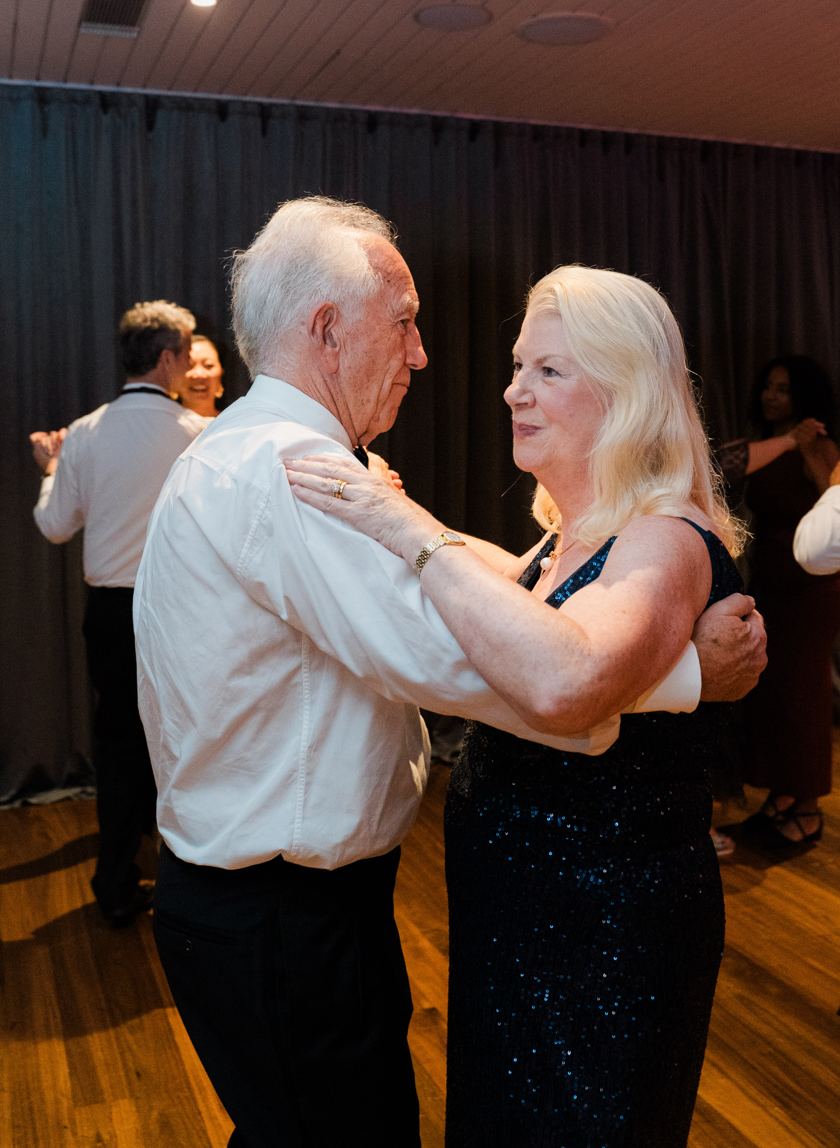
When a slow song comes on, take a simple hold: one person's right hand on the other's upper back, the other's left hand on their shoulder, free hands joined. Or go casual, with hands on the waist and the shoulders. Then sway gently from foot to foot in time, and every so often turn slowly in a small circle.
Keep the steps small, stand tall and let your shoulders drop. Talk, smile and do not worry about anything fancier. Our full guide to how to slow dance covers where to put your hands, how to turn and how to keep time.
Dancing with a partner who leads, or doesn't
If your partner has had lessons and starts leading proper steps, relax and go with it: keep your arms gently toned and let them guide the direction. A good lead keeps things simple for you. If you are the one with lessons, do the opposite: drop the fancy figures, stick to a basic step and make your partner look good.
If neither of you leads, agree on the side-to-side step and move together. It is surprisingly hard to look bad when two people are smiling and in time.
And when the great-uncle who can actually dance holds out his hand, say yes. He will steer you around the floor and you will both remember it.
Shoes, outfits and wedding dance floor tips
Your shoes decide how long you last. Choose something you can walk in comfortably for hours; a block heel or a smooth-soled flat is far kinder than a stiletto on floorboards or grass. A spare pair of flats in your bag is an excellent idea. Rubber soles grip and can catch in a turn, so on a polished floor a leather sole helps.
Test your outfit at home by lifting your arms and taking a big step in front of a mirror. Tight skirts, stiff jackets and long hems all limit movement, so lose the jacket once the dancing starts. Outdoors, watch for uneven ground and keep turns small.
Wedding dance etiquette for guests
- The couple goes first. Wait until the first dance and any parent dances are over and the floor has been opened before you join.
- Do not hog the space. Keep your steps compact on a crowded floor and save bigger moves for when there is room.
- Ask nicely, and accept a no. Offer your hand with a simple invitation, and if someone declines, smile and move on.
- Include the couple. If they come your way, dance with them; it is their party and they want to celebrate with everyone.
- Leave drinks at the table. A crowded dance floor is no place for a full glass of red.
If the bridal party has a planned routine, give them the floor and be their loudest audience. And if you are in the bridal party with a routine to learn, our bridal party dance lessons are designed for exactly that.
Learning a couple of dances before a big wedding season
If you have a run of weddings ahead, or one that matters a lot, a few lessons make a real difference. A basic waltz, a simple rumba or cha cha and a little swing cover most of what a band or DJ is likely to play, and they mean you can say yes when someone asks you to dance.
That is what our social dance classes are for: dancing comfortably at real events, not performing. Most students start with a free introductory private session, with or without a partner, and a program shaped around the occasions on their calendar.
Common questions
Do I have to dance at a wedding?
No, and nobody should pressure you. It is worth trying one song, though: couples remember who joined them on the floor, and the first song is always the hardest. If you really would rather not, cheering from the edge of the floor and keeping the couple's table company are perfectly good contributions to the night.
What if I have no rhythm?
Almost everyone has more rhythm than they believe. Listen for the bass or the drum, nod your head to it for a few bars, then step to that same pulse. If you can walk in time, you can dance at a wedding. A little teaching turns that into real confidence surprisingly quickly, even for people who have never danced.
Can I ask the bride or groom to dance?
Yes, once the floor is open. Keep it to a song, because they have a room full of people to see, and let them set the mood. A dance with the couple is one of the nicest memories of a wedding, for them as much as for you, so do not wait to be asked.