

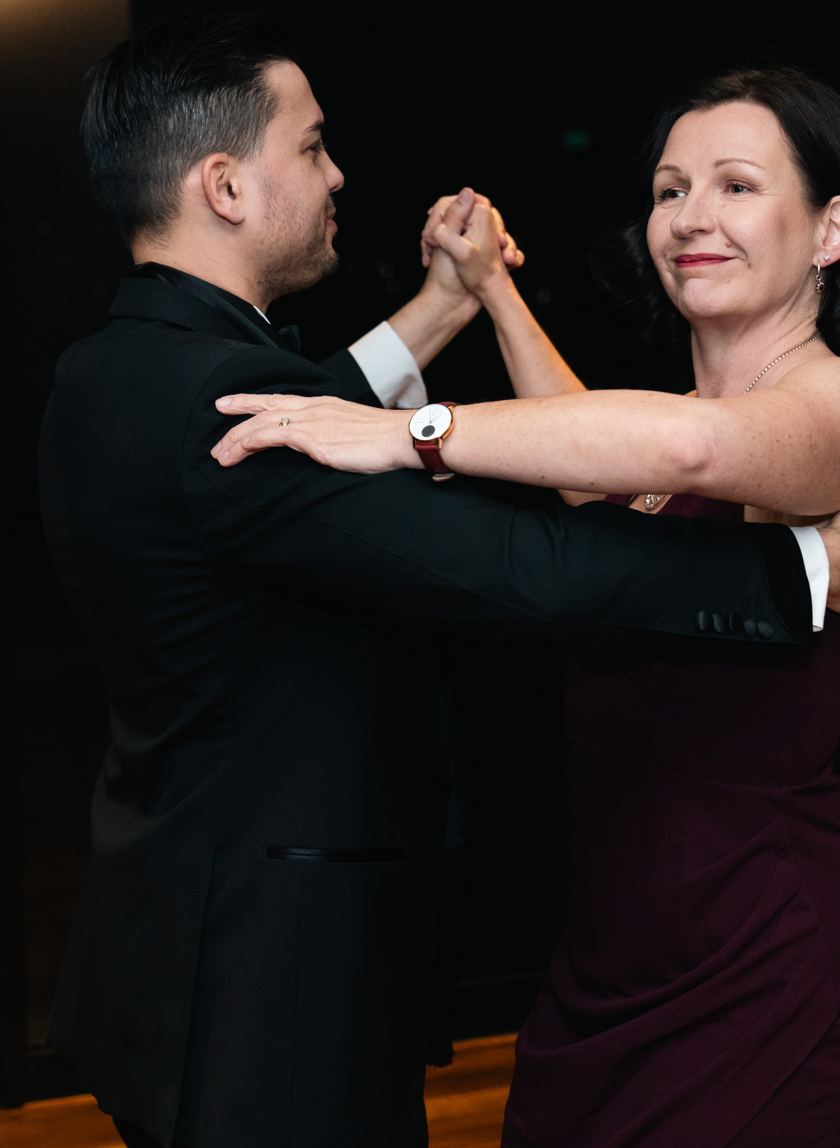
Learning how to waltz comes down to three things: counting in threes, holding your partner well, and a six-step pattern called the box step. Get those right and you can dance a recognisable waltz in a single session, then spend years making it beautiful. Here is each piece, written out the way we teach it to adult beginners in our Rozelle studio.
Waltz timing: counting in three-four
The waltz is written in three-four time: the music groups its beats in threes, ONE, two, three, ONE, two, three. The first beat of each group is the strong one, and every new figure starts there. Most music on the radio counts in fours, so a waltz feels like a tune that has learned to sway.
Before you take a step, put on a waltz and tap the one on your knee. Then count aloud and rock gently from foot to foot on each beat. If you can sway in time, you already have the part most beginners worry about, and it is where our waltz for beginners lessons start.
The waltz hold: standing with your partner
The waltz is danced in closed hold. The leader's right hand rests on the follower's left shoulder blade, the follower's left hand sits lightly on the leader's right shoulder or upper arm, and the leader's left hand holds the follower's right hand at about the follower's eye level. Stand slightly offset, each of you a little to your own left, so your right foot sits between your partner's feet.
Think of the hold as a frame: elbows lifted, shoulders down, back tall. It should be toned rather than rigid, like carrying a large, light box. When the frame keeps its shape, the leader can steer with the body instead of the arms, which is the subject of our guide to leading and following.
The waltz box step for leader and follower
The box step is six steps across two bars of music, and it traces a small square on the floor. It is one phrase, repeated: forward, side, close, then back, side, close. The leader starts by going forward, the follower by going back, and every step lands on a beat.
The leader's box step
Begin with your weight on your right foot, so the left is free. Each line is one beat.
- Count 1: step forward with your left foot.
- Count 2: step to the side with your right foot.
- Count 3: close your left foot to your right, taking your weight onto it.
- Count 1: step back with your right foot.
- Count 2: step to the side with your left foot.
- Count 3: close your right foot to your left, taking your weight onto it.
The follower's box step
Begin with your weight on your left foot, so the right is free. Your steps mirror the leader's, beat for beat.
- Count 1: step back with your right foot.
- Count 2: step to the side with your left foot.
- Count 3: close your right foot to your left, taking your weight onto it.
- Count 1: step forward with your left foot.
- Count 2: step to the side with your right foot.
- Count 3: close your left foot to your right, taking your weight onto it.
Closing the feet means a full change of weight, not a polite tap. If you end up on the wrong foot, the close is almost always where it went astray.
Rise and fall, and turning the box
Rise and fall in simple terms
Rise and fall is what makes a waltz look like a waltz rather than a brisk walk around a square. On count one you are down, knees softly flexed, stepping through with a heel lead when you go forward. You begin to rise at the end of one, come up onto the balls of your feet through two and three, then lower at the end of three, ready to go again. Keep it small at first: a gentle swell is plenty.
Turning the box
Once the box feels automatic, the leader can turn it. Beginners usually learn the left turning box first: on the forward step the leader turns the left toe out a little and the couple rotates about a quarter to the left over three steps, and on the back step the right toe turns in to carry the rotation on. Four half boxes bring you all the way round, while the follower keeps dancing the same pattern.
Common waltz mistakes beginners make
We see these in nearly every first waltz. All are easy to fix once you know they are there.
- Looking at your feet. Your head is heavy, and dropping it pulls your frame forward and your partner off balance.
- Taking big steps. A beginner's box should be smaller than a normal walking stride, never a lunge.
- Skipping the weight change. If the closing foot never takes your weight, you start the next bar on the wrong foot.
- Racing the music. Nerves speed people up, so let the three beats breathe and arrive on the one.
- Steering with the arms. Pushing and pulling through the hands reads as shoving, so move your body and let the frame carry the message.
- Bouncing on every beat. Rise and fall is one smooth swell across the bar, not three little hops.
Practising the waltz to music
Practise little and often. A few short sessions a week beat one long one, because the box step lives in muscle memory and muscle memory fades with gaps. Start without music, counting aloud, then add a song once the pattern runs on its own.
Choose music with a clear, steady three and an unhurried tempo. These are a few we like for practice.
- Moon River, Andy Williams. It is slow and smooth, and the one sits exactly where you expect it.
- Could I Have This Dance, Anne Murray. This gentle country waltz has a beat you can hear from the next room.
- Tennessee Waltz, Patti Page. The job is in the title, and the tempo never wanders.
- Kiss from a Rose, Seal. It is a modern track ballroom dancers have waltzed to for years.
- A Thousand Years, Christina Perri. It is a popular wedding choice and worth knowing if a first dance is coming up.
One local warning. Despite its name, Waltzing Matilda is not a waltz, so save it for the barbecue.
Where the waltz takes you next
The box step is the doorway to a whole family of figures. The waltz is also the classic wedding dance: a simple, well-led waltz to your own song looks lovely in photos and survives nerves, and our wedding waltz lessons build one around your music.
Later comes the Viennese waltz, roughly twice as fast and built on continuous rotation, which is a thrill once your balance and frame are ready. The foxtrot shares the same smooth travel and gentle rise and fall in a count of four. Our waltz lessons and classes page shows how they fit together, and the free introductory private session is the easiest way to try your first box with a teacher.
Common questions
Is the waltz a good first dance for beginners?
Yes, for most adults. The pattern is simple, the tempo is unhurried and the music announces its count clearly, so progress comes quickly. The waltz also teaches frame, posture and travelling around the floor, which carry straight into the foxtrot and tango. Still deciding? Our guide on how to dance as a beginner covers other good starting points.
Which way do you travel around the floor in a waltz?
Anticlockwise, along what dancers call the line of dance. The box step stays roughly on the spot, but once you add travelling figures you move around the room with other couples, and that is where floor craft comes in. Our guide to social dance etiquette explains how to share a busy floor without bumping anyone.
How long does it take to learn the waltz?
The box step often feels comfortable within your first session. Rise and fall, smooth turns and a relaxed connection take regular practice over the following weeks, and a wedding waltz to one song is a shorter project than waltzing socially. Everyone's pace differs, which is why a good teacher sets a plan after seeing you dance, not before.