

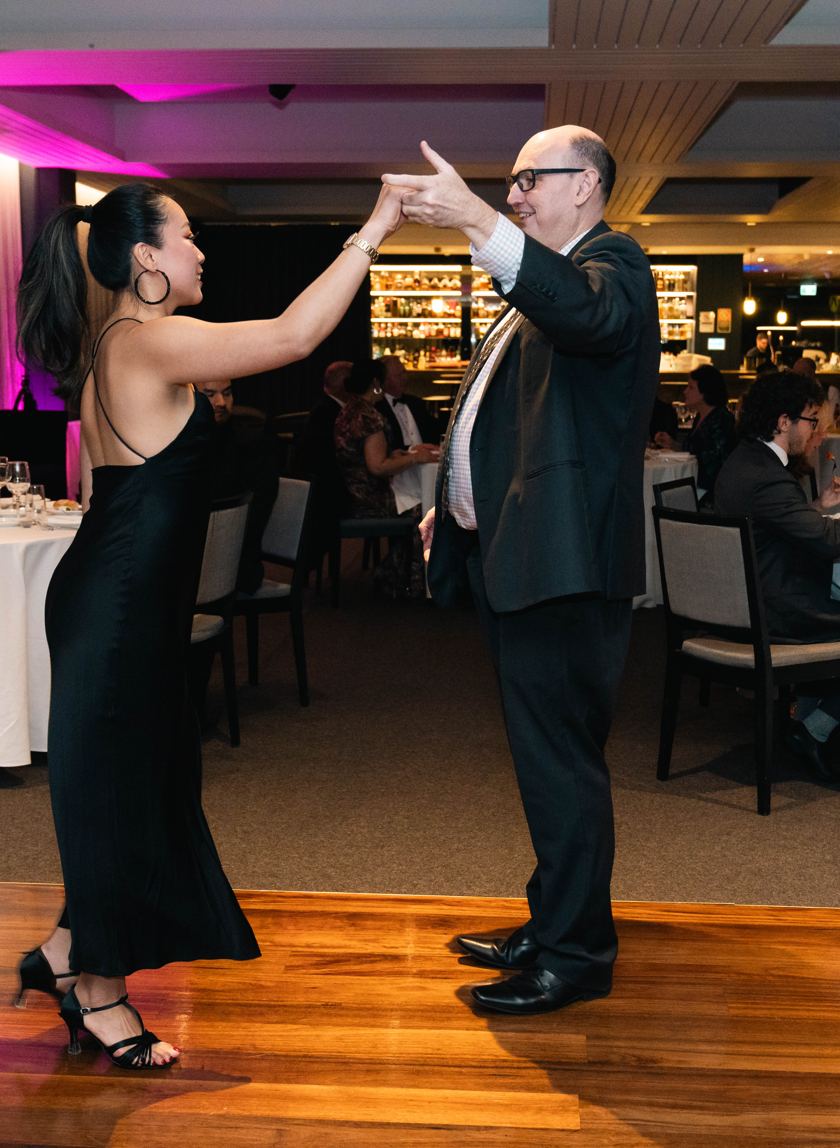
If you want to know how to dance, start smaller than you think: find the beat, move your weight in time with it, and stand tall while you do it. Everything else, from a wedding waltz to a confident night on a social floor, is built on those three habits. Here is how adult beginners with no experience at all actually learn, and what the first weeks feel like.
Finding the beat
Every song has a steady pulse underneath it, usually carried by the bass or the drums, and dancing starts with hearing it. Put on a song you like, ignore the singer for a moment, and tap your foot or nod along to that pulse. If you can do that, you have rhythm, whatever you were told at school.
Next, count it. Most popular music groups its beats in fours and the waltz groups them in threes, and each group begins with a stronger beat that dancers call the one. Clap on every beat, then only on the one, and you are listening the way dancers do.
In our experience, people who say they have no rhythm have usually just never been shown where to listen. It is one of the first things a teacher sorts out, often within minutes.
Weight changes and small steps
Dancing is, at heart, walking in time with music. Every step is a weight change: one foot takes all of your weight, the other is free to move, and on the next beat they swap. Hovering with half your weight on each foot is the most common reason beginners end up on the wrong foot.
Try it at home. Stand with your feet together, shift your weight fully onto one foot on each beat, then turn that into small steps forward and back. Keep the steps shorter than your normal walking stride, so your body stays over your feet and your balance stays with you.
It sounds almost too simple, and it is the foundation of everything. It is also exactly where our beginner-friendly dance classes begin, because every dance you will ever learn is built on it.
Posture: the beginner dance tip that changes everything
Good posture makes you look like a dancer long before you feel like one. Stand tall as if a string is lifting the crown of your head, let your shoulders drop away from your ears, and keep your chin level and your eyes up. Soften your knees slightly and keep your weight towards the front of your feet rather than back on your heels.
Posture is practical, too. A tall body balances better, turns more easily and is far easier for a partner to lead or follow. The urge to look down at your feet is strong, and resisting it is the most useful habit a beginner can build.
The first partner dances worth learning
If you have no experience at all, start with the dances that suit the occasions you actually go to. For most adults that means the social ballroom and Latin dances, which work at weddings, parties, cruises and dinner dances, and which teach skills that carry into everything else.
- Waltz. It is unhurried, elegant and built on a simple six-step box, and our guide on how to waltz writes it out step by step.
- Foxtrot. It is smooth and travelling, and it suits a great deal of popular music, from swing standards to modern ballads.
- Rumba. It is slow, romantic and danced mostly on the spot, which makes it a friend to crowded floors and first dances.
- Cha cha. It is playful and rhythmic, with a little triple step that teaches timing beautifully.
- Ballroom tango. It is dramatic and crisp, and surprisingly accessible once your posture is in place.
Not sure which appeals? That is completely normal, and our guide to choosing a style of dance walks through the decision in more detail.
Why learning to dance from videos stalls
Videos are a lovely way to get curious and a poor way to learn partner dancing. You are copying a mirror image at someone else's speed, nobody can see what you are doing wrong, and you cannot feel a lead through a screen. Plenty of people get a few steps in, then quietly stop, convinced the problem is them.
The bigger risk is habits. Self-taught dancers often arrive with half weight changes, a dropped head and arms doing the steering, and unlearning those takes longer than learning properly would have. A teacher watching only you catches each habit as it forms, which is the quiet case for starting with a personalised program rather than a playlist.
How to choose where to learn
Look for a place that teaches adults the way adults learn: patiently, with clear explanations and without an audience. A few things are worth checking before you sign up anywhere.
- Private lessons are available. One-to-one teaching, with the teacher as your partner, is the fastest and least nervous way in.
- There is a plan, not just a class pass. Ask how the studio decides what you learn next and how it reviews your progress.
- You can practise somewhere friendly. Social nights for students give you a real floor without a room full of strangers.
- The first step is low pressure. A free or trial session lets you meet the teacher before you commit to anything.
- It suits your goals. A competition school and an adult social dance studio are different places, and most beginners are looking for the second.
If nerves are the main thing holding you back, our page on dance lessons for shy beginners explains how we look after them. At CareToDance the first step is a free introductory private session, and you need no partner and no experience to book it.
What the first weeks feel like
The first lesson usually surprises people in a good way: within the hour you are doing something that looks like dancing. If you would like the whole hour laid out in advance, we have written up what happens in a first dance lesson.
The next few weeks are a mix. Some lessons click and some feel clumsier than the first one did, because your brain now knows more than your feet can do. That wobble is normal and it passes, especially if you practise a little between lessons.
Expect tired calves, a few laughs at yourself, and a moment, often at a social night, when you realise you have danced a whole song without thinking about your feet. That is the moment people come back for.
Common questions
What is the easiest dance for a complete beginner?
For most adults, the waltz or the rumba. The waltz has a simple repeating pattern and music with an obvious count, while the rumba is slow and stays mostly in one spot, so both feel achievable in a first lesson. Social foxtrot is another gentle start, and a good teacher will suggest one based on the music you love and the occasions you want to dance at.
Is it too late to learn to dance as an adult?
No. Many of our students are in their 50s, 60s and beyond, and some started after 70. Social and ballroom dancing were made for adults, and a good teacher shapes the steps to your body rather than the other way round. Our page on dance classes for adults over 50 goes into more detail about how we teach later starters.
Do I need a partner to learn to dance?
No. In a private lesson your teacher is your partner, and plenty of students start on their own, while couples are just as welcome. Learning without a partner can even be quicker at first, because you are dancing with someone who leads or follows correctly every time. That means you learn what the right feeling is before you try to find it with someone else.