

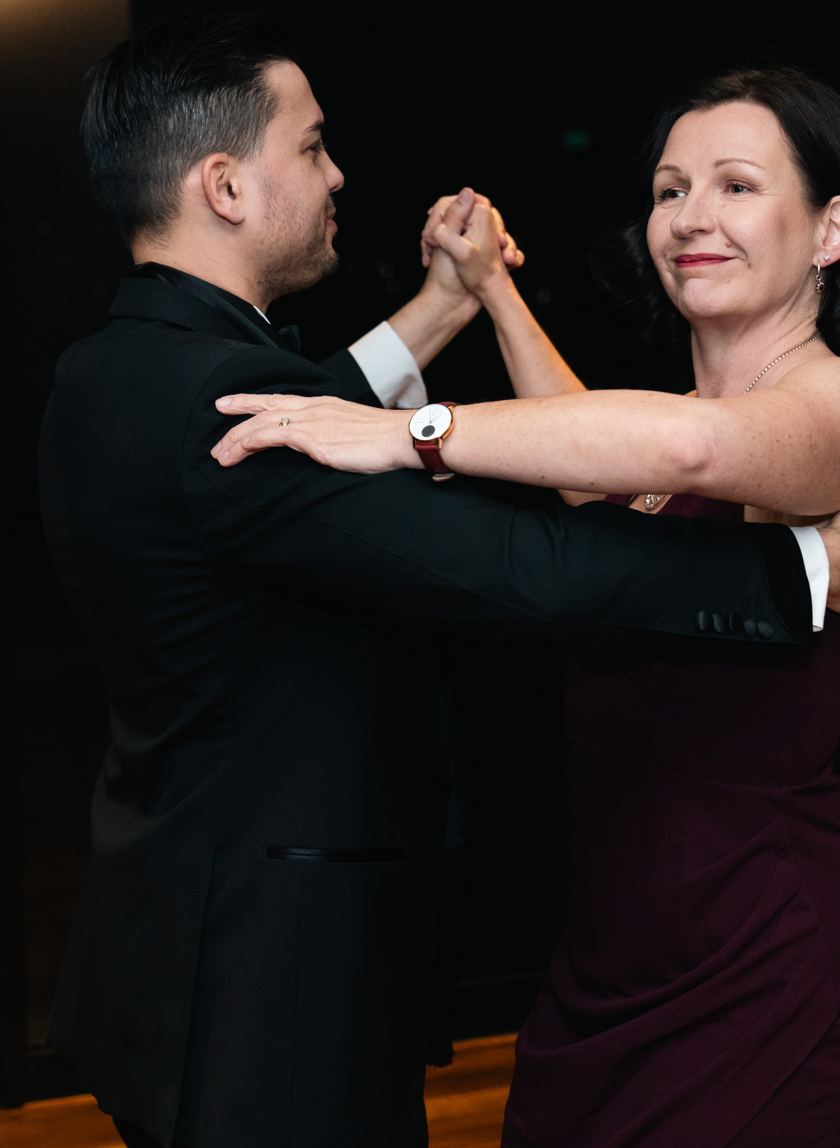
The benefits of dancing for seniors are real, and they go well beyond exercise: steadier balance, a body that keeps moving, a brain kept busy learning, and a room full of people to share it with. We teach a great many older beginners, so here is an honest account of what dancing can do as you get older, and what nobody should promise.
Dancing for seniors: why it suits an older body
Dancing is one of the few activities that scales gracefully with age. A social waltz or rumba moves at roughly walking pace, the steps are taught in small pieces, and you choose how lively to go. There is little impact, no equipment, and no point at which you are expected to keep up with someone half your age.
It also adapts to the body you actually have. In a private lesson your teacher works around stiff knees, a grumpy shoulder or a hip that prefers small steps, and builds from there. That is the approach behind our dance classes for adults over 50, where many students are in their 60s and beyond and some began after 70.
Dancing for balance and coordination
Every dance is a sequence of controlled weight changes: forwards, backwards, sideways and turning, often while listening to music and paying attention to a partner. That is balance and coordination practice disguised as fun. Over time, students tend to notice they stand taller, step more confidently and feel steadier on their feet.
This matters because balance and leg strength are central to staying independent. The falls guidance from healthdirect encourages people to keep physically active to stay strong and improve balance and lower the risk of falls, and names dancing among the suitable activities, alongside tai chi and group exercise. Dancing is no substitute for medical advice, but it is a pleasant way to keep practising the skills that matter.
Staying active in a way you will keep doing
The physical side goes beyond balance. A lesson or a social night keeps you moving for a good stretch at a time, works the legs and core, and encourages the upright posture that years at a desk or bent over the garden tend to undo. Livelier dances such as cha cha or swing raise the heart rate more; gentler ones such as waltz and foxtrot keep things steady.
The real advantage, though, is that people keep doing it. Exercise you dread tends to lapse. Dancing comes with music, friends and a skill you are steadily improving, so it stays on the calendar. If you want the fitness detail, our guide to whether dancing is good exercise compares the styles honestly.
Dancing and brain health: memory and concentration
Learning to dance is a mental workout as much as a physical one. You memorise sequences, recall them a week later, fit steps to the phrasing of the music and adjust in real time to a partner. For many older students it is the first time in years they have learned something genuinely new, and that feels good in itself.
We are careful here. Dancing is not a cure for anything and it is not a guaranteed protection, and anyone who promises that is overselling. What we can say is that it combines physical activity, learning and social contact in one enjoyable habit, and staying active, curious and connected is widely encouraged as part of ageing well.
Music has a special place for people living with dementia, which we wrote about in how social dancing can be therapeutic for people with dementia. In 2023 the studio and Dementia Australia hosted the Dance for Dementia Inner West Gala Ball, where eleven local business owners and community leaders trained for months and performed for more than 500 guests, raising more than $110,000 for Dementia Australia. You can read more about our Dance for Dementia work.
The social benefits of dancing
Social circles often shrink as children move out, careers end and friends move away. Social dancing answers that in a very direct way, because you cannot partner dance alone. Every lesson involves conversation, eye contact, laughter at the steps that went wrong and the small, friendly contact of a dance hold.
It also gives you a community rather than a single class. Our monthly social parties each have a different theme, the teachers dance too, and dinner and dance events run through the year. Plenty of students come as couples and plenty come alone, and both find their people quickly.
Mood, confidence and the family wedding
Music lifts the mood, and so does doing something well. Getting a new figure right, or finally getting through a whole foxtrot without looking at your feet, gives a small, honest jolt of achievement that most adults do not get often enough.
Confidence follows. Students who arrived nervous find themselves accepting invitations to dance at weddings, birthdays and on cruises rather than staying in their chair. Being the grandparent who leads the waltz at a family wedding is a very particular kind of pleasure. For more of the everyday reasons people start, see our great reasons to start dancing.
Common questions
What is the best type of dance for seniors?
Gentle partner dances are the usual starting point: waltz, foxtrot and rumba move at an easy pace and build balance and posture without strain. Once you are comfortable, livelier styles such as cha cha, swing or Viennese waltz add more cardio. The best choice is the one whose music you love, because that is what keeps you coming back.
Is dancing safe if I have arthritis or joint problems?
Many people with stiff or sore joints dance happily, but check with your doctor first and follow their advice. Tell your teacher about any limits so steps can be adapted, shortened or left out. Private lessons make this easy because everything is paced to you. Comfortable shoes with a smooth sole also reduce the strain on knees when you turn.
Can you start dancing in your 70s?
Yes. Some of our students began after 70, and like most of our students they started as complete beginners. You learn at your own pace, beginning with simple steps at walking speed, and you never need to do more than your body is comfortable with. The free introductory private session is a relaxed way to find out, with no experience or partner needed.
How often should seniors dance to feel the benefits?
Regularity matters more than intensity. Australia's activity guidelines encourage older adults to be active on most days, including activities for balance and coordination, so dancing once or twice a week alongside walking and other movement fits well. Practising your steps at home between lessons, even for a few minutes, also helps you remember them.